Scissor Lift or 2-Post Lift: Which One Should You Choose for Your Garage?
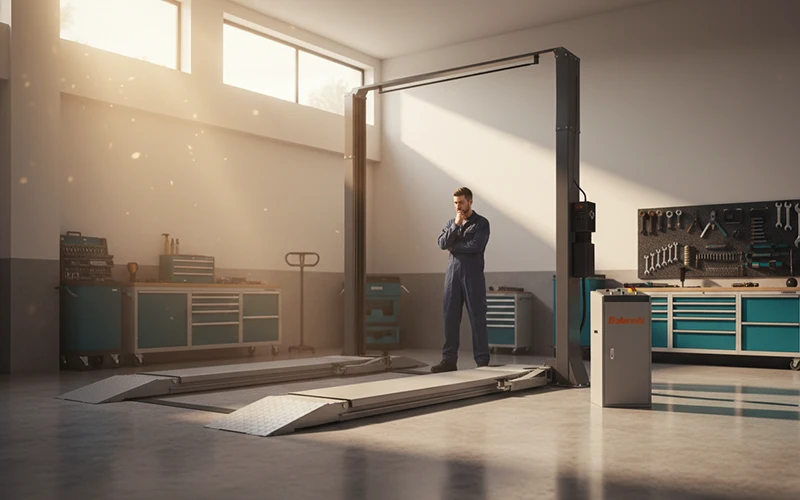
Selecting the right lift for your auto shop fundamentally influences operational efficiency, technician safety, and overall service capabilities. Auto scissor lifts and 2-post car lifts each deliver unique benefits designed for distinct shop requirements. Comprehending their essential differences will empower you in determining the optimal lift for your facility.
Understanding Auto Scissor Lifts
Auto scissor lifts utilize an X-shaped scissor mechanism, raising vehicles vertically with precision. These lifts deliver efficient space utilization, making them especially valuable for shops with restricted floor area. They are frequently employed for rapid repairs, wheel alignments, tire servicing, and brake work. Auto scissor lifts’ streamlined design and straightforward installation requirements enable smooth integration into current shop configurations.
Understanding 2-Post Car Lifts
2-post car lifts comprise two vertical columns with adjustable arms engineered to safely elevate vehicles via frame rails or specified lift points. These lifts deliver exceptional access underneath vehicles, perfect for thorough repairs including exhaust systems, transmissions, engines, and suspension components. Installation generally demands reinforced concrete flooring and adequate overhead clearance, ensuring operational stability and technician safety.
Comparative Analysis: Auto Scissor Lifts vs. 2-Post Car Lifts
Space and Installation
Auto scissor lifts demand minimal floor space and can be flush-mounted or surface-mounted, delivering optimal floor utilization. This characteristic makes them perfect for shops restricted by space or ceiling height constraints.
Conversely, 2-post car lifts necessitate more considerable space and structural support due to their height and anchoring demands. They are better suited for larger operations equipped to accommodate more extensive installations.
Vehicle Accessibility
Auto scissor lifts deliver adequate access for routine service tasks such as brakes, tire rotations, and alignments. However, their configuration somewhat restricts complete vehicle underside access.
In contrast, 2-post car lifts deliver total undercarriage access, perfect for complex repairs and thorough vehicle servicing. The open configuration ensures unrestricted technician movement beneath the vehicle.
Versatility and Usage
Auto scissor lifts deliver uncomplicated, swift lifting suited for quick service applications. Technicians benefit from the simplicity of vehicle placement and efficient lift operation, improving service speed and technician productivity.
2-post car lifts deliver enhanced versatility in servicing diverse vehicle types and performing extensive mechanical repairs. Their adjustable arms accommodate different vehicle sizes and configurations, though they demand accurate positioning.
| Feature | Auto Scissor Lift | 2-Post Car Lift |
| Space Efficiency | High, perfect for limited spaces | Low, demands larger area |
| Undercarriage Access | Limited, perfect for quick tasks | Extensive, appropriate for heavy tasks |
| Installation Ease | Easy, minimal infrastructure | Complex, reinforced demands |
| Operational Use | Quick maintenance and alignment | Comprehensive mechanical repairs |
When to Select an Auto Scissor Lift
Shops emphasizing space-saving configurations, rapid service tasks, and uncomplicated installation should consider an auto scissor lift. These lifts are exceptional for facilities conducting frequent tire and alignment services, ensuring optimal productivity and workspace adaptability. Shops with restricted vertical or horizontal space benefit significantly from this lift type’s compact footprint.
When to Select a 2-Post Car Lift
Operations consistently performing complex and extensive vehicle repairs will find 2-post car lifts advantageous. Perfect for comprehensive services like engine rebuilds, suspension modifications, and complete underbody inspections, these lifts deliver exceptional access. Shops servicing varied vehicle types, including heavier commercial vehicles, benefit from the versatility and capacity of 2-post car lifts.
Maintenance Considerations
Routine inspections and preventive maintenance are essential for both lift types. Auto scissor lifts demand checks on hydraulic systems, pivot lubrication, and locking mechanisms. Similarly, 2-post car lifts require thorough inspections of hydraulic cylinders, lift arm conditions, anchoring systems, and safety locks to prevent incidents.
Technician training is vital for both lifts, emphasizing safe operating practices, proper vehicle alignment, and emergency response protocols.
Conclusion
Determining between auto scissor lifts and 2-post car lifts depends on specific shop requirements, including space availability, service task types, and installation capabilities. Auto scissor lifts deliver excellent space efficiency, ease of operation, and suitability for quick maintenance tasks, making them perfect for smaller or specialized shops. Conversely, 2-post car lifts deliver comprehensive undercarriage access, supporting extensive and versatile automotive repair operations.
Assessing these factors carefully will ensure optimal lift selection, enhancing your facility’s productivity, technician comfort, and service capabilities. Quality automotive shop equipment exemplifies robust, efficient, and reliable solutions, delivering exceptional value to automotive service professionals seeking performance and dependability.
Frequently Asked Questions (FAQs)
Which lift type is better for smaller auto shops?
Auto scissor lifts are optimal for smaller or space-restricted shops due to their compact, space-efficient configuration.
Can auto scissor lifts perform wheel alignments?
Yes, quality auto scissor lifts equipped with reinforced platforms and alignment-specific accessories deliver precise alignment capabilities.
What are the concrete requirements for 2-post car lifts?
2-post car lifts demand reinforced concrete flooring, typically at least four inches thick, ensuring adequate structural support for safe operation.
Which lift type delivers easier vehicle positioning?
Auto scissor lifts deliver quicker and simpler vehicle positioning due to their straightforward design and central lifting mechanism.
Are scissor lifts appropriate for heavy-duty trucks?
Auto scissor lifts typically accommodate vehicles weighing up to 16,000 pounds, adequate for most passenger vehicles and light trucks. For heavier vehicles, 2-post car lifts may be more appropriate.